Why I Cook on a Kamado: One Grill That Does Everything

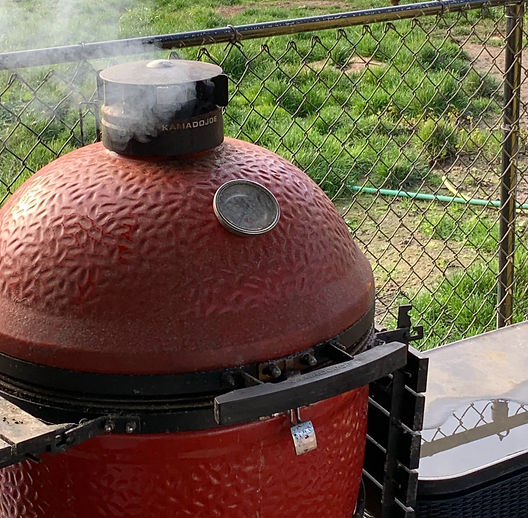
I’ve cooked on a lot of different grills. Cheap charcoal grills. High-end gas setups. Offset smokers. I’ve owned some. Borrowed others. Cooked on plenty. But the kamado sits in the best spot on my patio. That is not an accident.
Once upon a time, my stepdad said to me, "I would like to buy you a BBQ. Choose one that's around $1,000." Challenge absolutely accepted.
I spent hours and hours reading blogs, looking at product reviews, having stress dreams about choosing the wrong one, and going back and forth in my mind about the pros and cons of different types of grills. When it came to decision time, there was only one choice: the Kamado Joe.
Could I have got a Big Green Egg instead? Yes, but the Kamado Joe name makes me laugh. Both are built around the same basic idea: thick ceramic walls, charcoal heat, tight airflow control, and enough versatility to make most other grills feel a little one-dimensional.
For how I cook, the kamado is the best all-around backyard grill. It smokes, sears, roasts, bakes, grills, and turns into a pizza oven when you want to pretend your patio is Naples with better parking.
If I could only keep one grill, it would be the kamado. Not because it’s the cheapest.
Not because it’s the fastest. Because it does almost everything well. (here's where to learn about essential kamado accessories)
Ceramic Magic (Ceragic?)
The whole kamado thing comes down to ceramic, airflow, and heat retention.
That sounds boring until you cook on one.
A kamado has thick ceramic walls that hold heat incredibly well. Once it gets hot, it stays hot. The dome shape helps circulate heat around the inside, almost like an outdoor convection oven that happens to run on charcoal and make your neighbors jealous.
What this means practically:
Temperature swings are small.
Once you set it around 250°F, it can hold there for hours.
You’re not babysitting vents every 10 minutes.
Charcoal lasts a long time.
The cooking environment stays moist.
Meat stays juicy.
That’s the thing people don’t always understand until they use one. A kamado is not just “a charcoal grill, but heavier.” It cooks differently. The ceramic body traps heat and moisture, and that gives you a much more controlled cooking environment. Once you learn the vents, the grill starts to feel less like a fire pit and more like a machine that just happens to run on lump charcoal.
A very heavy, very hot, very useful machine.
The Temperature Range
This is the real reason I love the kamado.
You can smoke low and slow at 225°F. You can roast chicken at 400°F. You can sear steaks at 700°F. You can push it even hotter for pizza. That means you’re not buying one grill for smoking, another for searing, and another outdoor oven for pizza. You own one thing, and it does all of it well.
Real-world temperature breakdown:
Smoking: 225°F to 275°F
Brisket
Ribs
Pork shoulder
Lamb shoulder
Chicken
Salmon
Hot cooking: 350°F to 500°F
Roasted chicken
Vegetables
Fish
Sausages
Weeknight grilling
Searing: 600°F to 700°F
Steaks
Chops
Burgers
Reverse-sear finishes
Pizza: 700°F to 800°F+
Crisp crust
Charred edges
Melted cheese
Backyard pizza night without buying a standalone oven
That range is the whole argument. A gas grill can be convenient. A pellet smoker can be easy. An offset can give you incredible smoke. A flat top can crush breakfast and smash burgers.
But the kamado is the one that says, “Sure, I can do that too.”
Annoyingly smug? Maybe. Accurate? Also yes.
Fuel Efficiency
Kamados are surprisingly efficient. Because the ceramic holds heat so well, you’re not constantly burning through fuel to maintain temperature. A good load of lump charcoal can last through a long cook, and depending on what you’re making, you may still have charcoal left for the next one.
That matters. Charcoal is not free. Neither are pellets or propane. But a kamado makes great use of the fuel you give it, and it lasts a LONG time. You don't need to worry about loading in more charcoal when you're smoking a brisket for 24 hours. Just sit back and let the Joe work its magic.
Why it’s efficient:
Ceramic walls retain heat.
Airflow is tightly controlled.
Lump charcoal burns slowly when vents are dialed in.
You can shut down the vents after cooking and save unused charcoal.
Long cooks don’t require constant refueling.
Over time, that adds up. You’ll still buy charcoal. You’ll still convince yourself you need “just one more bag” because it’s on sale. That’s part of the lifestyle. But compared to some other setups, the kamado makes fuel feel like it’s working with you instead of vanishing into the sky like a smoky tax.
The Moisture Thing
This is one of the biggest advantages of a kamado. The dome is tight. The ceramic holds heat. Airflow is controlled. Moisture does not escape as quickly as it does in many traditional grills or smokers. That matters because BBQ is basically a long negotiation between heat, moisture, fat, and time.
On a kamado, the cooking environment stays more humid, and the meat tends to stay juicier.
A roasted chicken on a kamado can be ridiculous. Crispy skin outside, juicy meat inside, and just enough charcoal flavor to make the oven version seem like it gave up. Same with ribs. You can build real bark without drying them out. Same with pork shoulder. Same with lamb shoulder. The grill gives you a better margin for error.
That doesn’t mean the kamado magically makes bad cooking good. You can still overcook things. You can still ignore temperature and create sadness. But it does give you a very forgiving environment. And in backyard BBQ, forgiveness is underrated.
The Consistency Factor
Gas grills have hot spots. Charcoal grills have zones. Offset smokers have gradients. A kamado still has heat zones, but the ceramic dome and thick walls help even things out more than you’d expect.
Once the grill stabilizes, it becomes incredibly consistent.
Practical impact:
You don’t have to rotate food constantly.
You don’t have wild temperature swings once dialed in.
You can trust the grill during long cooks.
You can focus on the food instead of fighting the fire.
You can bake in it. Hello, smoked lasagna!
That steadiness is the difference between relaxing while dinner cooks and pacing around the patio like brisket has taken your family hostage.
The Flavor
Kamados cook with charcoal, and charcoal matters. You get that live-fire flavor you don’t get from propane. You can add wood chunks for smoke. You can keep it mild with fruitwoods or go stronger with hickory or oak. It’s the difference between “food cooked outside” and “food that tastes like it came from a real fire.”
The Aesthetics
Let’s be honest: Kamados look cool. That matters a little. You put a Kamado Joe or Big Green Egg on the patio and suddenly the space looks intentional. It looks like cooking happens there. Real cooking. The kind involving smoke, meat, and a person who owns more than one kind of salt.
Is this the main reason to buy a kamado? No. Is it a nice bonus when people come over and immediately say, “Whoa, what is that thing?” Absolutely.
The Learning Curve
There is a learning curve. Not a terrible one, but it exists. You need to understand vent control. The bottom vent controls how much oxygen gets to the fire. The top vent helps fine-tune the temperature and airflow.
At first, this feels mysterious. Then after a few cooks, it starts to make sense. The basics:
More airflow means more heat.
Less airflow means lower heat.
Big changes take time.
Tiny vent adjustments matter.
Don’t chase the temperature every two minutes.
Let the grill settle.
By your third or fourth cook, it starts becoming muscle memory. That’s the trade-off: a little bit of learning upfront in exchange for years of better cooking. Worth it.
The Limitations
Kamados are great, but they are not perfect.
Kamados are not ideal for:
High-volume cooking for 50 people.
Fast lazy grilling when you want food in 8 minutes.
Tiny patios where space is already tight.
People who do not want to deal with charcoal.
Anyone who hates waiting for a grill to come up to temperature.
Massive cooks unless you have a larger model or accessories.
The cooking surface can also be limiting, especially on an 18-inch model. That size is great for most backyard cooking, but if you’re doing full briskets often, big turkeys, large quantities of ribs, or a lot of meal prep, you may want the larger size.
Also, kamados are heavy. Not “kind of heavy.” Heavy heavy. Moving one is not a casual Tuesday decision. It is an event involving planning, regret, and probably one friend who gets suspiciously quiet when lifting begins.
The Cost Reality
Kamados are not the cheapest grills. You can spend a few hundred dollars on an entry-level kamado, or you can spend well over a thousand dollars on a premium model from Kamado Joe or Big Green Egg.
General price ranges:
Entry-level kamados: around $300 to $500. These aren't worth it in my opinion because they'rd hard to clean and you'll throw your shoulder out opening the lid. Just get a Kamado Joe or Big Green Egg; over time it'll be worth the extra money.
Mid-range kamados: around $800 to $1,500
Premium kamados: around $1,500 to $3,000+
You are paying more upfront than you would for a basic charcoal grill. But you are also getting a cooker that can smoke, grill, roast, sear, bake, and make pizza. If you use it often, the value starts to make sense. This is a long-term patio investment.
The Versatility Argument
This is the real superpower. A kamado replaces a lot of cooking situations. With one grill, you can:
Smoke ribs.
Smoke brisket.
Smoke pork shoulder.
Smoke lamb shoulder.
Roast chicken.
Grill vegetables.
Sear steaks.
Reverse sear thick cuts.
Make pizza.
Bake bread.
Cook fish.
Grill weeknight chicken.
Make holiday turkey.
Cook low, medium, hot, or screaming hot.
That is why I cook on a kamado. Other people buy a grill and a smoker. Then maybe a pizza oven. Then maybe another cooker because the first two don’t do exactly what they want.
Now, I still love my Blackstone. The flat top does things the kamado doesn’t. Breakfast burritos, smash burgers, fried rice, hash browns, bacon, and reverse sears all make the Blackstone worth having. But if we’re talking about one grill, one main backyard cooker, the kamado is the center of the setup.
The Bottom Line
I cook on a kamado because it is the single best investment I’ve made in my patio cooking setup.
It’s not the cheapest grill. It’s not the fastest. It’s not the easiest on day one. But it is the one that does almost everything I actually want to cook. It’s beautiful. It’s efficient. It holds temperature like it has a PhD in thermodynamics. It makes excellent food and keeps rewarding you the more you learn how to use it.
Five years in, I’m still finding new ways to cook on it. That’s the best kind of grill.
Affiliate Disclosure: Some of the links above may be affiliate links. If you purchase through these links, Bus Stop BBQ may earn a small commission at no extra cost to you. We only recommend products we genuinely use and believe in.


Comments