Every Type of Grill Explained: Charcoal, Gas, Pellet, Kamado, and More

Updated: May 8
Walk into any big box store during grilling season and you’ll see a wall of metal, ceramic, propane tanks, side burners, pellet hoppers, and price tags that make you briefly reconsider indoor cooking.
Charcoal. Gas. Pellet. Kamado. Flat top. Offset. Some weird hybrid grill that looks like it was designed during a committee meeting. It’s a lot.
The good news is that most grills are not “better” or “worse” in some universal way. They’re just built for different kinds of cooking. Some are fast. Some are smoky. Some are precise. Some are romantic in the “I spent six hours tending a fire and now I smell like oak” kind of way.
Here’s the breakdown.
This is what most people picture when they think of backyard grilling.
A metal bowl or barrel. Charcoal underneath. Grates on top. Fire, food, smoke, and the ancient human desire to stand outside with tongs.
The Weber Kettle is the classic example here, and for good reason. It’s affordable, durable, and can do way more than people give it credit for.
How it works:
Light charcoal and let it ash over for about 15 to 20 minutes.
Move coals to one side for indirect cooking.
Place food over direct heat for searing or away from the coals for slower cooking.
Adjust temperature with the vents.
Add wood chunks if you want extra smoke flavor.
Pros:
Affordable compared to most serious grills.
Great charcoal flavor.
Simple design with very little to break.
Teaches you fire management.
Can grill, smoke, and roast if you know how to set it up.
Cons:
Takes longer to get cooking than gas.
Requires charcoal storage.
Creates ash you have to clean out.
Temperature control takes practice.
Wind and weather can make things more interesting than you asked for.
Best for:
People who enjoy the ritual.
Flavor obsessives.
Backyard cooks on a budget.
Anyone who wants to actually learn fire management.
The honest take:
Charcoal is still one of the best ways to cook outside. It’s not the fastest or easiest, but it gives you real flavor and makes you feel like you’re doing something older than Wi-Fi.
Gas grills are the weeknight warriors.
Propane tank. Burners. Grates. Lid. Push the button, wait a few minutes, and cook.
I use Weber for traditional propane grills because they’re reliable, easy to use, and don’t make weeknight dinner feel like a wilderness survival course.
How it works:
Turn on the propane.
Hit the ignition.
Set your burners.
Preheat for 5 to 10 minutes.
Cook like you would on an outdoor stove with grill grates.
Pros:
Fast startup.
Easy temperature control.
Minimal cleanup compared to charcoal.
Great for weeknight cooking.
Consistent results.
Good for families and frequent grilling.
Cons:
Less smoke flavor than charcoal or wood.
Propane heat is convenient but less dynamic.
Burners and grease traps need maintenance.
Can feel a little sterile if you love the fire ritual.
Flare-ups can happen if grease management gets sloppy.
Best for:
Busy families.
People who grill multiple times a week.
Weeknight burgers, chicken, sausages, and vegetables.
Anyone who values speed and consistency.
The honest take:
Gas grills are not the most romantic option, but they are incredibly useful. Sometimes you don’t need a spiritual encounter with smoke. Sometimes you need chicken thighs done before everyone gets hangry.
Pellet grills are for people who want real wood smoke flavor without babysitting a fire all day.
A hopper feeds wood pellets into a firebox. A controller manages the temperature. You set it, monitor it, and let the grill do most of the work. Traeger is the big name here, and they helped make pellet smokers mainstream for backyard cooks.
How it works:
Load wood pellets into the hopper.
Set your target temperature.
An auger feeds pellets into the firebox.
A fan and controller manage the burn.
The grill maintains temperature automatically.
Pros:
Very easy to use.
Excellent temperature control.
Real wood smoke flavor.
Great for low-and-slow cooking.
Can smoke, roast, bake, and grill.
Less babysitting than charcoal or offset smoking.
Cons:
More expensive than basic charcoal or gas grills.
Requires electricity.
Mechanical parts can break.
Pellet quality matters.
Still needs regular cleaning.
Doesn’t always sear as hard as charcoal, gas, or a flat top.
Best for:
People who want to smoke regularly without constant fire management.
Weekend BBQ cooks.
Brisket, pork shoulder, ribs, chicken, turkey, and salmon.
Anyone who likes the idea of outdoor cooking but not the “poke the fire every 20 minutes” lifestyle.
The honest take:
Pellet grills are convenient, consistent, and very good at smoking. Are they as hands-on and primal as an offset? No. But sometimes “easy and delicious” wins, and that’s not a crime.
Kamados are where I spend a lot of my time.
Thick ceramic walls. Dome shape. Charcoal inside. Top and bottom vents controlling airflow. These things can hold steady at 225°F for low-and-slow smoking, then turn around and rip past 700°F for steaks or pizza.
Kamado Joe and Big Green Egg are the big names to know here. I personally like Kamado Joe, especially the Classic Joe size for most backyard cooking.
How it works:
Fill the firebox with lump charcoal.
Light the charcoal with fire starters.
Use the bottom and top vents to control airflow.
Ceramic walls retain heat and moisture.
Adjust vents to smoke low and slow or sear hot and fast.
Pros:
Incredibly versatile.
Great for smoking, grilling, searing, roasting, baking, and pizza.
Very fuel efficient.
Holds temperature well once dialed in.
Ceramic body doesn’t rust.
Looks great on the patio.
Produces excellent charcoal flavor.
Cons:
More expensive upfront.
Heavy and annoying to move.
Has a learning curve with vent control.
Startup takes longer than gas.
Accessories can add up fast.
Cheap kamados can have annoying lids, bad hardware, or frustrating ash cleanup. Get the Kamado Joe or Big Green Egg!
Best for:
People who want one grill that can do almost everything.
Flavor fanatics.
Backyard cooks who like both smoking and high-heat grilling.
Anyone looking for a long-term outdoor cooking setup.
The honest take:
A good kamado feels like a backyard cheat code. Smoke ribs, roast chicken, sear steaks, make pizza, cook vegetables, bake bread if you’re feeling ambitious. The whole thing is basically a ceramic dragon egg that eats charcoal and rewards patience.
A quick buying note:
Kamado Joe and Big Green Egg are the safest brand callouts.
If buying Kamado Joe, I’d look at Series II or Series III because the spring-loaded lid is worth it and a good ash system matters more than you think. There is nothing worse than a kamado lid that feels like opening a bank vault. Except maybe a terrible ash catcher that makes cleanup feel like archaeology.
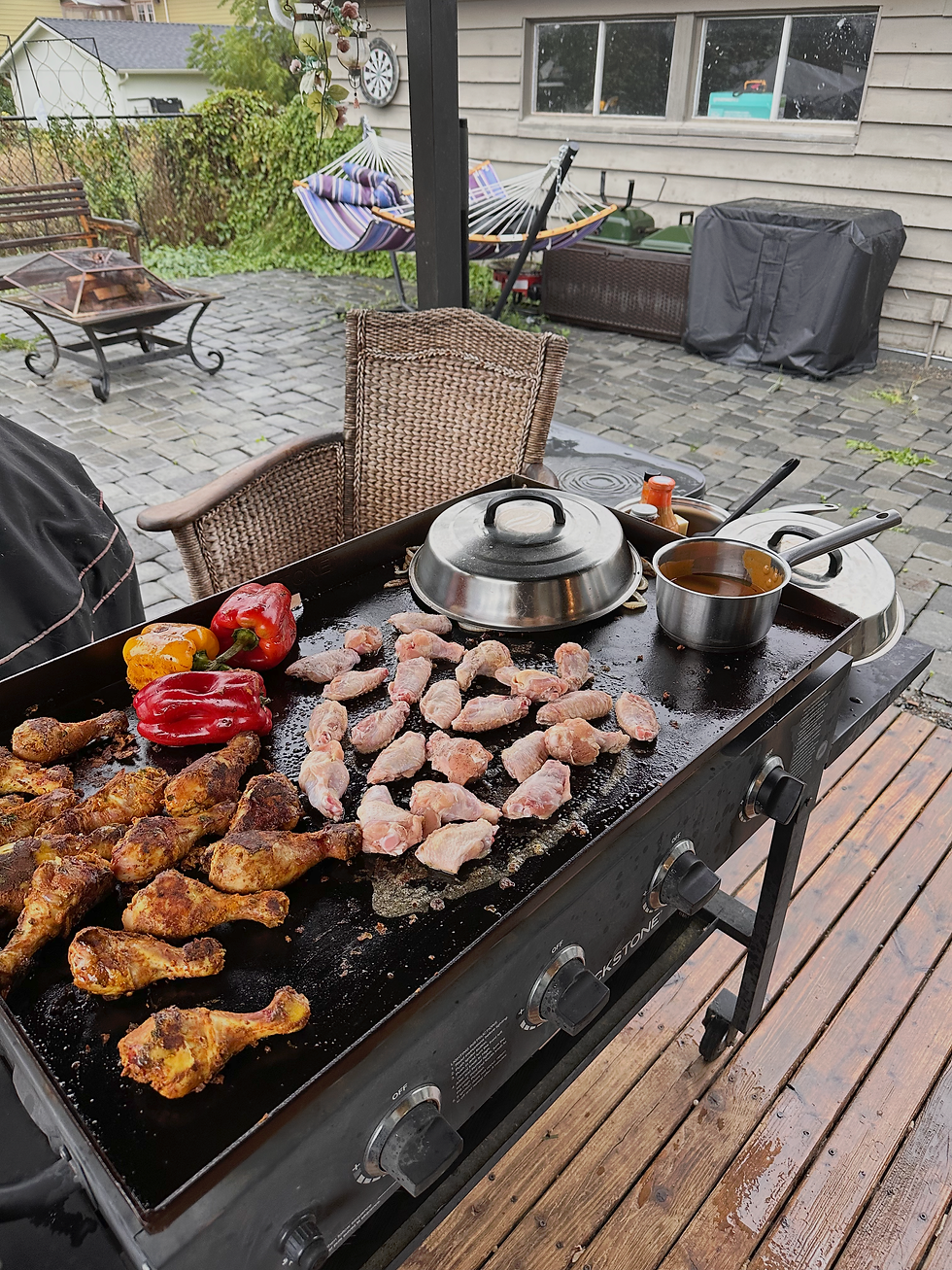
A flat top grill is a steel cooking surface with propane burners underneath. No grates. No bars. No food falling into the flames and disappearing forever.
Blackstone is the name most people know here, and for good reason. They helped turn the backyard flat top into a regular-person patio staple instead of something you only saw at diners, food trucks, and tailgates.
How it works:
Propane burners heat a flat steel surface.
You cook directly on the steel.
Grease drains into a grease trap.
You use spatulas, scrapers, squirt bottles, and oil.
Multiple burners let you create heat zones.
Pros:
Huge cooking surface.
Great for cooking volume.
Perfect for breakfast, smash burgers, fried rice, quesadillas, cheesesteaks, and stir fry.
No flare-ups.
Small foods don’t fall through grates.
Great temperature control across zones.
Cons:
Not built for smoky flavor.
Requires seasoning and maintenance.
Takes up patio space.
Grease cleanup is part of the deal.
Less “traditional BBQ” atmosphere.
Best for:
Breakfast lovers.
Smash burger people.
Anyone who wants to cook for a crowd.
Outdoor brunch.
Fried rice, quesadillas, cheesesteaks, fajitas, hash browns, bacon, and eggs.
People who already have a grill or smoker and want the missing piece.
The honest take:
A Blackstone does not replace a grill. It completes the lineup.
With a kamado and a Blackstone, I can do almost everything I want outside. Smoke on the kamado. Sear on the Blackstone. Make breakfast burritos. Reverse sear steaks. Cook bacon, then throw hash browns into the bacon grease like nature intended.
A flat top turns outdoor cooking into full-meal cooking, not just “meat over fire.”
Offset smokers are the old-school BBQ machines. Firebox on the side. Main cooking chamber. Chimney. Wood or charcoal burning in one chamber, heat and smoke moving through the other.
This is the rig you picture when someone says they stayed up all night tending a brisket.
How it works:
Build a fire in the side firebox.
Heat and smoke travel into the main chamber.
Food cooks low and slow with indirect heat.
You manage temperature by feeding the fire and adjusting airflow.
Smoke exits through the chimney.
Pros:
Incredible smoke flavor.
Authentic BBQ experience.
Great for large cuts and bigger cooks.
Can handle a lot of meat.
Looks awesome.
Gives you maximum fire control if you know what you’re doing.
Cons:
Steep learning curve.
Requires active fire management.
Takes up space.
Uses a lot of wood or fuel.
Cheap offsets can leak smoke and heat.
Not ideal if you want easy weeknight cooking.
Best for:
Serious smoking.
Brisket, pork shoulder, ribs, turkey, and sausage.
People who enjoy tending a live fire.
BBQ purists.
Anyone who thinks “six hours of fire management” sounds relaxing.
The honest take:
Offsets are amazing, but they are not casual. They demand attention. If you want the traditional BBQ experience, this is it. If you want to set the temperature and go watch a movie, this is not it.
A Korean BBQ grill is its own thing. This is not “stand outside alone flipping burgers while everyone else waits inside” cooking. This is social cooking. The grill is part of the meal, part of the table, and part of the whole experience.
Korean BBQ is built around thin-sliced meats, marinades, banchan, lettuce wraps, dipping sauces, and everyone cooking together. It’s less “I made dinner for you” and more “we are all now responsible for this delicious chaos.”
How it works:
A grill sits at the center of the table or on a portable tabletop burner.
Thin-sliced meat cooks quickly over high heat.
Common cuts include short rib, brisket, pork belly, ribeye, and chicken.
You serve it with rice, lettuce, kimchi, banchan, sauces, and vegetables.
Everyone eats as things come off the grill.
Pros:
Extremely fun for groups.
Great for interactive dinners.
Thin cuts cook quickly.
Marinades and sauces do a lot of flavor work.
Perfect for indoor/outdoor entertaining depending on your setup.
Makes dinner feel like an event.
Cons:
Not built for big low-and-slow BBQ.
Requires prep: slicing meat, making sides, setting up sauces.
Can get smoky depending on the grill and ventilation.
Smaller cooking surface than a backyard grill.
You need people comfortable cooking and eating in rounds.
Best for:
Group dinners.
Korean BBQ nights.
Thin-sliced beef, pork belly, chicken, and short ribs.
Lettuce wraps, rice bowls, and banchan spreads.
People who want cooking to be part of the hangout.
The honest take:
A Korean grill is not a replacement for a gas grill, kamado, or pellet smoker. It’s a different lane entirely. It’s one of the best options when you want dinner to be interactive.
Everyone gathers around, food keeps coming off hot, and somehow the table ends up covered in grilled meat, sauces, kimchi, lettuce, and people saying, “Just one more piece.” That’s usually a lie. But a good lie.
Fire Pits: The Atmospheric Option
A fire pit is not really a grill in the modern sense, but it can absolutely cook food. It’s the oldest setup on the list: fire, coals, grate or skewers, and someone poking at logs like they’re negotiating with nature.
How it works:
Build a wood fire.
Let the fire burn down to coals.
Cook over the coals using a grate, skewers, or cast iron.
Manage heat by moving food closer or farther from the coals.
Pros:
Simple.
Great atmosphere.
Works for camping or casual backyard cooking.
Can be inexpensive.
Makes everything feel more primal in a good way.
Cons:
Temperature control is vague.
Takes time to burn down to usable coals.
Not ideal for precision cooking.
Limited cooking space.
Smoke direction will betray you personally.
Best for:
Camping.
Backyard gatherings.
Skewers, sausages, foil packs, cast iron, and simple grilling.
People who care as much about the vibe as the meal.
The honest take:
A fire pit is more atmosphere than cooking appliance, but that’s not an insult. Sometimes the fire is the point, and the food is just a very good excuse to stand around it.
Hybrid Grills and Weird Stuff
There are gas-charcoal combos. Pellet-gas combos. Smokers with side burners. Grills that look like they need firmware updates and a therapist. Some of them are useful. Some of them are trying to solve a problem you may not actually have.
Before buying a hybrid grill, ask yourself:
Do I truly need both fuel types in one unit?
Will I actually use both sides?
Is this better than buying two simpler tools?
Am I buying flexibility or just buying confusion?
Most hybrid owners end up using one side most of the time and the other side occasionally. That doesn’t make hybrids bad. It just means you should be honest about how you cook.
How to Choose the Right Grill
Here’s the simpler version.
Pick charcoal if:
You cook once or twice a week.
You enjoy the ritual.
You want great flavor on a budget.
You want to learn fire control.
Pick gas if:
You cook multiple times a week.
You want speed and consistency.
You need dinner done without a whole production.
You like the convenience of propane.
Pick pellet if:
You want to smoke regularly.
You don’t want to babysit charcoal or wood all day.
You like set-it-and-monitor-it cooking.
You have access to good pellets and an outlet.
Pick kamado if:
You want one grill that can do almost everything.
You care about charcoal flavor.
You want to smoke, sear, roast, grill, and make pizza.
You’re willing to invest and learn the vents.
Pick flat top if:
You cook breakfast or lunch outside.
You love smash burgers.
You want volume and surface area.
You already have a grill or smoker and want more flexibility.
Pick offset if:
You are serious about smoking.
You want the traditional wood-fired BBQ experience.
You have space and patience.
You enjoy managing a live fire.
Pick Korean BBQ grill if:
You want interactive, social cooking.
You love Korean BBQ, banchan, lettuce wraps, and grilled meats.
You cook thin-sliced beef, pork belly, short ribs, or marinated chicken.
You want dinner to happen at the table, not just before the table.
You’re okay with prep work and cooking in rounds.
Pick fire pit if:
You want the vibe more than the precision.
You’re camping.
You like cooking simply over coals.
You accept that “temperature control” may mean moving a hot dog six inches to the left.
My Personal Take
For how I cook, the best combo is a Kamado Joe plus a Blackstone. That combo covers almost everything I want to do in the backyard.
I still like propane grills, and Weber is my go-to there. Gas is fast, convenient, and practical. I also get why people love Traegers and pellet smokers, especially for low-and-slow cooks without the babysitting. But if I’m building a backyard setup from scratch, I’m anchoring it with a kamado and adding a flat top as soon as possible.
The Bottom Line
The best grill is the one you’ll actually use.
That sounds obvious, but it matters. A $3,000 grill sitting under a cover all year is not better than a $200 charcoal grill that gets fired up every weekend. Buy for how you actually cook, not the fantasy version of yourself who wakes up every Saturday at 5 a.m. to trim brisket while listening to birds and questioning life choices.
If you want speed, get gas.
If you want flavor on a budget, get charcoal.
If you want low-and-slow with less babysitting, get a pellet grill.
If you want one cooker that can do almost everything, get a kamado.
If you want breakfast, burgers, fried rice, and brunch outside, get a flat top.
If you want the old-school BBQ experience, get an offset.
And if you just want people gathered around fire with a drink in hand, a fire pit still counts.
Pick the tool that matches the way you cook. Then use it.
Affiliate Disclosure: Some of the links above may be affiliate links. If you purchase through these links, Bus Stop BBQ may earn a small commission at no extra cost to you.


Comments